

A sense of mystery hangs in the air as we drive farther and farther into the countryside outside of Bloomington, along winding back roads through fields of grass, toward an address hard-fought to acquire and only by exclusive invitation. The car tires creep up a gravel drive, and I’m uncertain as I pull up to the house set back from the road. But this is no horror story; it’s closer to a treasure hunt, and we’ve been invited to the X marking the spot.
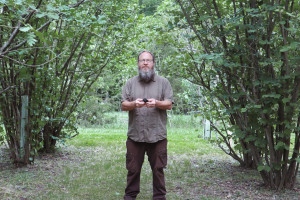
As the first visitors to this hidden location, we beat out local chefs and loyal vendors to see an Indiana black truffle as it’s pulled out of the soil. One step out the car door, camera at the ready, we are greeted by Wes Burton. Burton’s frame is sturdy, and his beard long and scraggly with shades of grey and white. Behind wire frames are icy, intelligent blue eyes. His hands are darkened with dirt, and he speaks with an enthusiasm for everything he does. He and his wife, Debi, planted the truffle orchard on their southern Indiana plot 23 years ago.
“Our kids grew, our coffee roasting business grew, and our truffle trees grew,” says Burton.
Truffles have gained a global reputation for the way they elevate risotto and other fine-dining dishes. With a flavor that sits somewhere between mushroom and garlic, truffles are known for their unique and decadent aroma, especially when freshly harvested. Practically speaking, the truffle itself is a fungus that grows on the roots of certain trees.
As we walk to the back of the property, a furry figure bounds up to greet us, restrained only by the leash that Debi Burton is gripping firmly. Hazel, a truffle-sniffing puppy in training, is easily excitable, but good at what she does. And without her, the treasures under the earth would be lost to the soil.
“Most truffles are underground and require either a pig or a trained dog to find them. You cannot simply go rooting around the trees,” says Burton, explaining that careless digging could destroy the mycelium network below.
The threat of truffle hunters is what keeps the Burtons closely guarded. Black truffle gold rush from someone ripping at the soil could destroy the whole truffle orchard in one fell swoop. Instead, the Burtons steward their trees, as they have done for 20 years, and have opened up shop to some of the best kitchens in Indianapolis, including Commission Row and Fishers-based personal chef and catering company Chefski. You might have tasted some of Burton’s 2024 crop at Magdalena, where owner/cook Nick Detrich used them in potato latkes with garlic aioli, with Indiana black truffles microplaned thinly on top.
“The biggest thing for me is the novelty,” says Detrich, “and we’re getting something that’s a pretty temperamental product, but with Wes’ stuff we’re getting it from the dirt to our hands in a matter of, sometimes, hours.”
Although native to regions of France and Italy, there are pockets of truffle orchards all over the world. In 2001, researcher Gerard Chevalier of the French National Institute for Agriculture, Food, and Environment published a paper on distinguishing between the Asiatic black truffle and the Perigord black truffle. The two types are cultivated in different parts of the world, but the Perigord, or French black truffle, is one of the most fragrant, and most expensive, varieties in the world. The Burtons credit Chevalier’s research with inspiring them, and by June 2002 they had planted truffle-inoculated oak and hazelnut trees in their backyard.
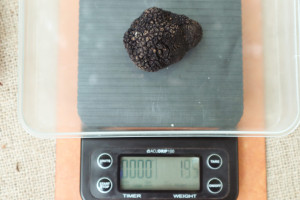
“Last season, they ran anywhere from $30 to $40 per ounce, which is roughly the size of a golf ball,” Burton says as he washes off the palm-sized truffle in a plastic bowl. The largest they’ve found weighed 12 ounces and measured roughly the size of a softball.
Although bountiful, the Burton’s truffle orchard required 20 years of waiting before they pulled the first black truffle from the ground.
“My sharp-eyed wife spotted something odd poking through the surface near a hazelnut bush,” says Burton. The area surrounding their trees had already sprouted bald patches called terre brulé, or scorched earth, which commonly heralds the coming of truffle production. A long wait, with bountiful returns.
RELATED STORIES
Pandan and Ube: Curiosity Is How Food Cultures Travel
How Salamat Cookies helped Indianapolis discover Filipino flavors -- Ube Fest is back October 19, 2026!
Rosie’s Gooey Butter Cookies: A Noblesville Favorite Launches Monthly Cookie Club
The melt-in-your-mouth Hoosier take on a midwest classic is now available by mail! Rosie's place has launched a cookie…

The Main Event: 5 Showstopping Desserts Across Indy
No meal is complete without a little sweet treat to cap it off with. Some desserts help satisfy a throbbing sweet tooth,…