

Rethink the school cafeteria as we celebrate 2025’s Indiana Food Day. The holiday is officially October 16th, but celebrated in Indiana schools from August through December.

With the school year back in full swing, it’s easy to spot the familiar sights of fall: fresh pencils, yellow school buses, and, of course, the school lunchroom. With all its social dynamics, “mystery” meat, and “lunch ladies,” school lunch has been the butt of jokes and a thing of news headlines for decades; but, its history goes back so much further than that.
It is also a part of my history. Not just as an American girl in public school at the turn of the millennium, experiencing lunch-room-famous rectangle pizza and the many brand partnerships that peppered schools before “Let’s Move” took hold. But, one of the first stops in my early food service career was serving as the Food and Nutrition Director for Tipton School Corporation.
I was 24 and eager. But, what I found were complex practices and a lot of challenges. I inherited a mountain of unpaid lunch tabs—some reaching four figures— that many days left me serving as a pseudo collections agent with a moral conundrum. Navigating the changing regulations from the First Lady, Michelle Obama, landed me in tricky partisan conversations. Not to mention, more than half of the staff I was to manage had been working in the lunch rooms longer than I had been alive. My naiveté about the world, food, and even childhood crashed hard into the reality that school lunch was so far from simple.
Instead, I learned its complexity is what makes it vital.
Hot Lunch History
The idea of feeding students in schools traces back to the 19th century. Then, childhood was gaining recognition as a unique and critical period of growth and development. States began to implement compulsory education laws which required children to attend school. The question of how to feed them during the day became increasingly important.
It wasn’t just the United States that was grappling with the issue. Countries like Italy, France, and Britain were also experimenting with serving lunch in schools. In most cases, these early programs were sustained through charitable efforts: families who could afford to pay did so, while those who couldn’t were provided meals for free.
Parent-teacher organizations and local home economics pioneers, like the Women’s Educational and Industrial Union in Boston, played an outsized role in establishing early school lunch programs. These groups organized volunteers to cook and serve hot meals, raised money for supplies, and even bought dining tables so students wouldn’t have to eat at their desks. But, unfortunately this was not a feature at all schools.
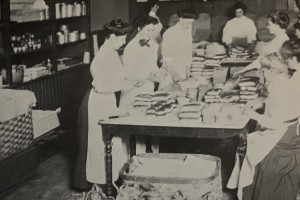
The federal government got involved when the Great Depression left the country with massive agricultural surpluses and no market to sell them. Then came World War II. When the results of the military draft revealed that 33% of young American men were unfit for service due to poor nutrition, it sent a sobering message: food insecurity was a national security issue.
As a result, Dr. Thomas Parran, Surgeon General of the United States Public Health Service from 1936 to 1948, made the statement, “We are wasting money trying to educate children with half-starved bodies. This is expensive stupidity, but its immediate cost to our education systems is nothing compared to the ultimate cost to the nation.”
In response, President Harry S. Truman signed the National School Lunch Act into law in June 1946. “In the long view,” Truman said, “no nation is any healthier than its children or more prosperous than its farmers.”
The Act formally linked the Department of Education and the Department of Agriculture, creating a system where surplus crops could be distributed to schools, feeding children while supporting American farmers. A dual-mission that is still alive today thanks to cost and farmer saving commodity support.
From the Cornfield to the Cafeteria
As a young creative millennial struggling in my food service director role, I knew there had to be a way to make school lunch fun, so I hopped on Google. There I learned of a new program called Farm to School. It was early 2012 and the local food movement was finding its footing. From practicality and the community connection to the education opportunities, it made so much sense to connect not just farmer surplus through the government; but also, actual local farms to school cafeterias. I immediately joined Indiana’s efforts, becoming the first food service director on the board.
For the next two years, I worked alongside representatives from the Department of Agriculture, Department of Education, Purdue extension, and even with farmers. We visited farms, schools in other states with programs in action, and took classes to better understand produce safety. As we worked to get the program off the ground, I shared my insight on the meal pattern guidelines, true cost, storage limitations, and labor and skill realities of school lunch programs. However, in many ways thanks to this experience, another job came to me and took me out of the K through 12 arena at the end of 2013.
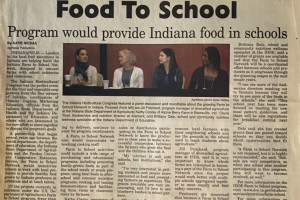
In the years that followed, Indiana Farm to School continued to not just grow, but flourish. Today, many schools have developed school gardens and even school farms complete with animals, making food education and lessons on how they grow possible. Many Indiana schools are also supporting local economies through local food procurement. Remembering the grassroots team we had in 2012 and seeing today’s map of participating local producers on Indiana Grown For School’s website delighted me. It was so full of red dots, you couldn’t make out any other color.
One of the best days to see their efforts in schools across the state is on the annual Indiana Food Day. The Indiana Department of Education, along with community groups and organizations across the state, promote Indiana Food Day annually to celebrate local food and healthy eating. The celebration is typically held every year in October to coincide with National Farm to School Month, but schools are encouraged to find any date from August to December to celebrate. In 2025 they are celebrating their 13th year of Indiana Food Day.
As part of the celebration, each participating school showcases a particular local food item. This offers students a chance to explore the culinary diversity of our state each year. The 2025 celebration features an item quintessentially “Indiana”: Sweet Corn.
Starting in the spring, schools were able to register for Food Day which included the opportunity to receive free corn seeds to plant and grow on site as well as plenty of materials such as brochures, coloring pages, recipes, and even stickers to help promote and use on Food Day. Connections to local farms were also made, if needed, to bring local corn to schools.
A New Generation
I am back in the school lunch world again—but, this time as a mom to two elementary school students who love to buy lunch from the school cafeteria. They come home gushing about the special “Try It!” produce days, a monthly Farm-to-School program that showcases a seasonal item complete with fun facts and tasting for all.

Recently, I spoke with our local director, Ashley Karshen, RDN, to hear about Tippecanoe County School Corporation’s Food Day, which they celebrated in late September. She excitedly shared that they received 200 ears of corn from local to Lafayette, Pence Ag, and purchased another 200 ears of corn from D&R, a local food market in Lafayette. Thanks to the local corn and the hard work of a handful of gloved, giggling, hair-netted third, fourth, and fifth grade classes who shucked the ears (many for the first time!), Cole Elementary School and Wyandotte Elementary School received a true farm-to-table experience right in the school cafeteria.
More than a Meal
From charity-led kitchens and post-war policy to school gardens and local procurement, the school lunch program has evolved into a cornerstone of American public health and education. It is so much more than just a midday meal and a late night show joke.
It’s a gateway to learning—about how to eat, agriculture, community, and where our food comes from. It’s a daily investment in our children’s health, in our local economies, and in our collective future—supporting physical nourishment, mental growth, and overall well-being.
Because when a child shucks an ear of corn, tastes a new vegetable, or shares a local apple with a friend, they’re not just eating lunch. They’re taking part in a system that feeds minds, fuels bodies, and builds stronger communities.
Not to mention, they are also having a lot of fun.
Check in with your local school corporation to see how they are celebrating Indiana Food Day. For school and grower resources, be sure to check out ingrown4schools.com.
RELATED STORIES

Cookbook Review: The Verdict on Karen Thi’s Spookie Cookies
On its surface this book might look like a sweet, seasonal romp in the kitchen, but in reality is more a reference on the…

Luxury Appliances for Distinctive Homes
Shopping for appliances doesn’t have to feel transactional. At Shuee’s Appliance in Indianapolis, a family-owned approach,…

Oktoberfest: Stories from Hoosiers Who Know It Best
Every fall, Hoosiers gather around beer steins, sausages and long communal tables to celebrate Oktoberfest. We talked with…